
Thermoformed ABS Sheets: Applications in Automotive, Equipment Housings and Industrial Packaging
ABS (Acrylonitrile Butadiene Styrene) is a widely used thermoplastic material for manufacturing durable, lightweight and visually appealing plastic components. With its good impact resistance, surface quality and thermoforming performance, ABS sheet is suitable for producing a wide range of custom-shaped products through vacuum forming.
From automotive exterior components and equipment protective covers to reusable industrial packaging trays, thermoformed ABS products serve various industries that require customized plastic parts with specific shapes and functional properties.
Vacuum thermoforming allows manufacturers to transform flat ABS sheets into three-dimensional components using heated sheets and custom-designed molds. Compared with injection molding, this process can offer greater flexibility for large-sized components, product development and projects where lower tooling investment is preferred.
In this article, we explore the key advantages of ABS sheets for vacuum thermoforming and their applications in automotive components, equipment housings and industrial packaging.
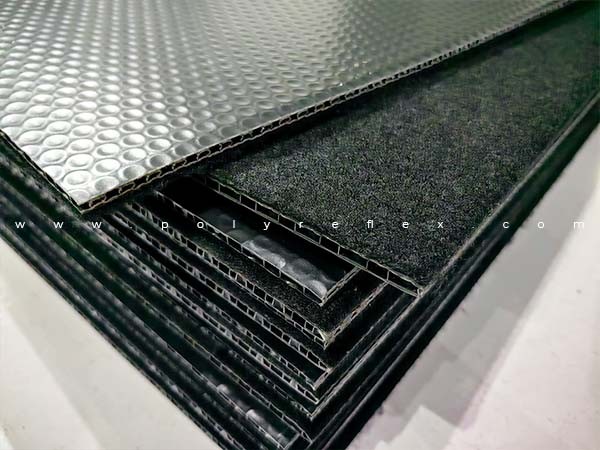
PP Bubble Board
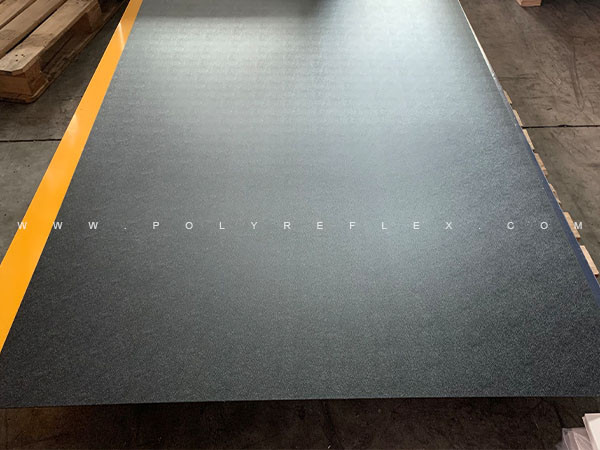
ABS Sheet
1. Why Choose ABS Sheets for Vacuum Thermoforming?
ABS is a popular material for thermoforming because it combines mechanical properties, processing flexibility and good surface appearance. These characteristics make it suitable for manufacturing both functional components and decorative plastic products.
1.1 Good Impact Resistance
ABS offers good impact resistance and toughness, helping formed components withstand everyday handling and mechanical contact.
This makes it suitable for applications such as equipment protective covers, automotive components and reusable industrial trays, where durability is an important consideration.
The actual impact performance depends on the ABS grade, sheet thickness, product geometry and operating environment.
1.2 Excellent Thermoforming Performance
ABS sheets can be heated until they become sufficiently pliable and then formed against a mold using vacuum pressure.
This process makes it possible to manufacture components with curved surfaces, recessed areas and customized three-dimensional shapes.
For manufacturers developing large plastic housings or custom-shaped covers, ABS thermoforming provides a practical way to produce components without requiring complex injection molds.
1.3 Good Surface Appearance
ABS sheets are available in different surface finishes to meet various product design requirements.
Common options include:
The appropriate surface finish can be selected according to the appearance and application requirements of the finished component.
1.4 Design Flexibility
Vacuum thermoforming supports the production of different shapes and sizes using customized molds.
It is particularly useful for large covers, equipment housings and components with relatively broad surface areas.
Manufacturers can develop products according to drawings, samples or specific design requirements, making the process suitable for customized projects and product development.
1.5 Suitable for Secondary Processing
After thermoforming, ABS components can undergo additional operations to achieve their final dimensions and functional requirements.
Depending on the product design, secondary processing may include:
These operations help transform thermoformed ABS sheets into finished components ready for further assembly or use.
2. Automotive Components Made from Thermoformed ABS Sheets
The automotive industry uses various thermoformed plastic components for vehicle exterior styling, protective covers and functional applications.
ABS sheets are suitable for manufacturing customized automotive components that require specific contours, surface finishes and dimensions.
2.1 Automotive Roof Cargo Boxes
Automotive roof cargo boxes provide additional storage capacity for luggage, outdoor equipment and other travel necessities.
Their upper and lower shells often feature large curved surfaces and aerodynamic shapes. Thermoforming ABS sheets is one manufacturing option for producing these plastic shells.
The process allows manufacturers to develop customized shapes according to the design of the cargo box, while CNC trimming can be used to achieve the required edges and dimensions.
Depending on the product design, additional operations such as drilling, assembly and installation of hinges or locking components may also be required.
2.2 Automotive Front Lips and Splitters
Automotive front lips and splitters are exterior components installed around the lower front section of a vehicle.
They contribute to the vehicle's exterior appearance and may also be designed to influence airflow around the front end.
ABS sheets can be thermoformed into customized front lip shapes with different contours and profiles. The formed components can then undergo trimming and machining to match the vehicle design.
For exterior applications, material selection should consider UV exposure, temperature changes and impact requirements. UV-resistant ABS grades or other weatherable material options may be considered depending on the intended application.
2.3 Automotive Fender Flares and Wheel Arch Trims
Fender flares and wheel arch trims are installed around vehicle wheel openings to provide additional coverage and enhance exterior styling.
These components often feature curved profiles that follow the shape of the vehicle body.
Thermoformed ABS sheets can be used to produce customized fender flare components with different widths, contours and surface finishes.
After forming, the components can be CNC trimmed and machined to achieve the required mounting edges and installation openings.
For vehicles exposed to outdoor environments, the selected material should also meet the project's weather resistance and durability requirements.
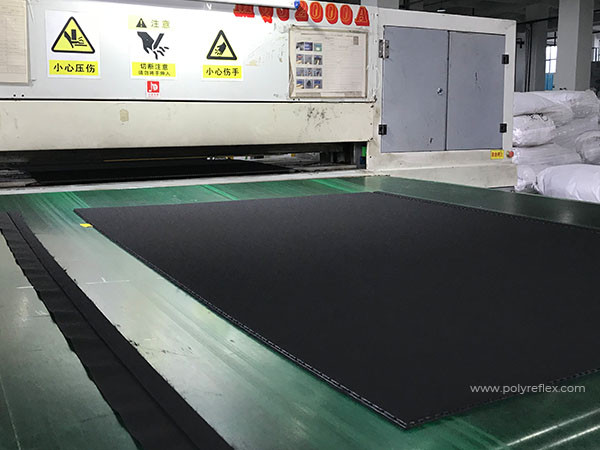
PP Bubble Board Production
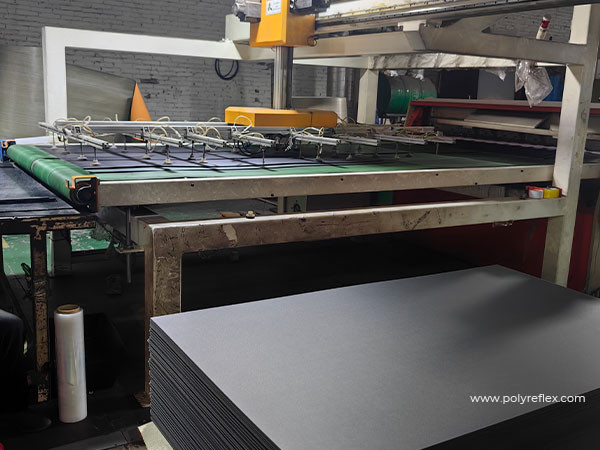
ABS Sheet Production
3. Equipment Housings and Protective Covers
Beyond automotive applications, ABS sheets are widely used in the manufacturing of plastic equipment housings and protective covers.
Many industrial and consumer equipment products require large plastic exterior components that combine functional protection with an attractive appearance.
Vacuum thermoforming provides a flexible manufacturing option for producing these customized housings.
3.1 Fitness Equipment Covers
Fitness equipment often contains mechanical transmission systems, electrical components and moving parts that require external protection.
Thermoformed ABS covers can be used for different parts of fitness machines, including:
ABS sheets can be formed into curved and contoured shapes according to the equipment structure.
Their surface appearance and available color options also make them suitable for fitness products where the overall equipment design is important.
3.2 Tanning Equipment Housings
Tanning equipment, including tanning beds and other UV tanning devices, often requires large plastic exterior housings and protective covers.
These components may feature elongated shapes, curved surfaces and customized openings to accommodate the internal equipment structure.
ABS sheet thermoforming provides a way to manufacture these large plastic shells according to the equipment design.
Depending on the application, manufacturers may require customized sheet thicknesses, colors and surface finishes to meet product appearance and structural requirements.
For equipment exposed to elevated temperatures or UV radiation, the material grade should be evaluated against the actual operating conditions.
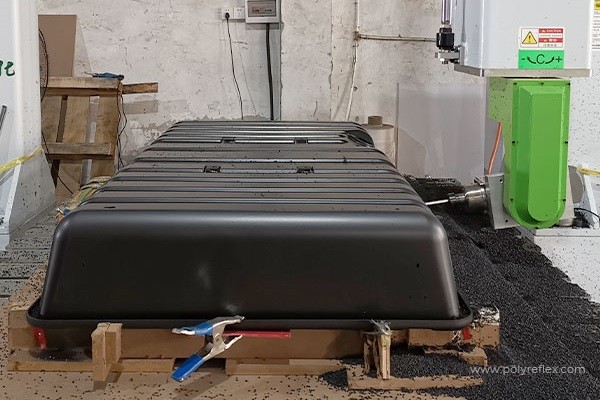
CNC Machining
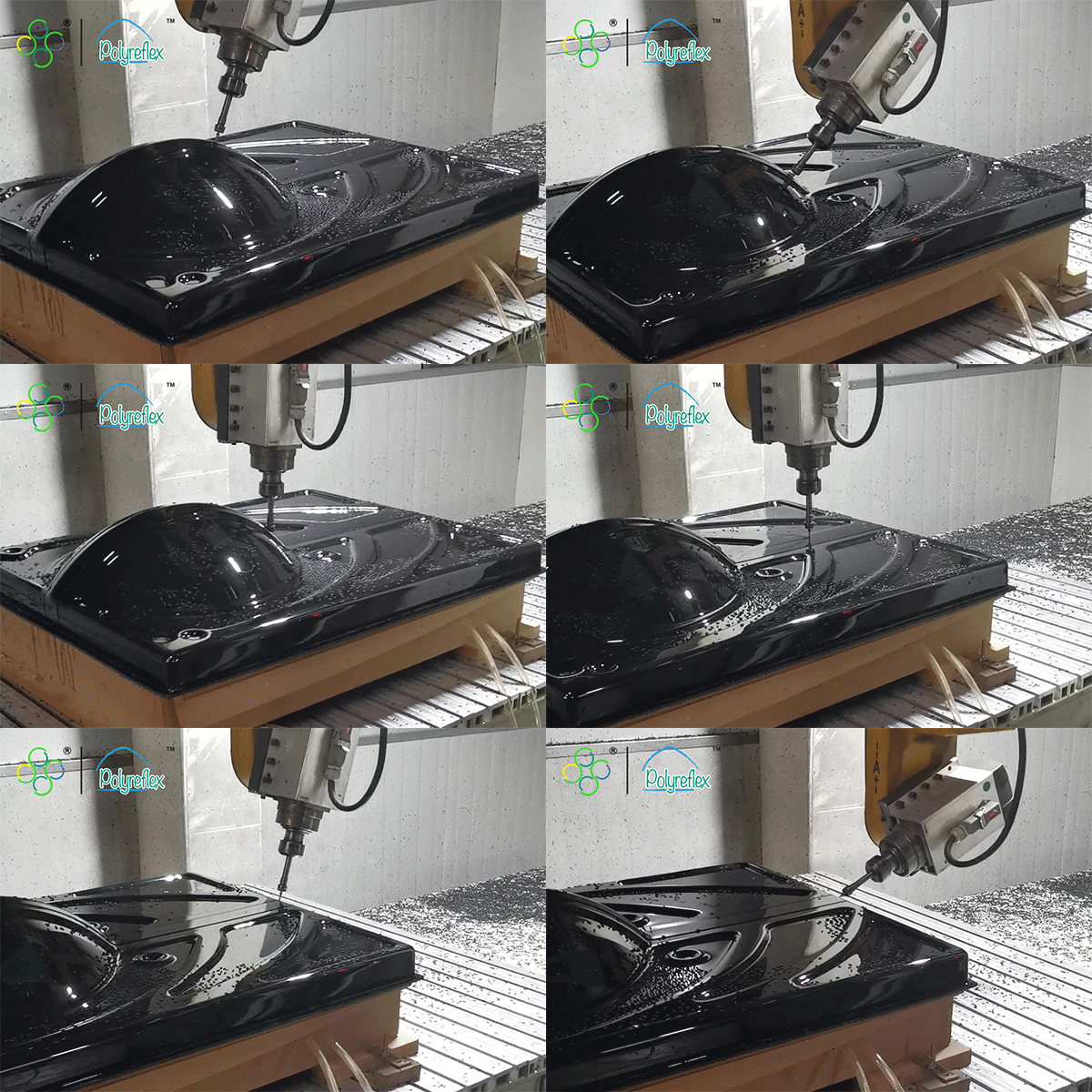
ABS Part CNC Machining
4. Industrial Packaging and Material Handling Solutions
Thermoformed ABS sheets also serve industrial packaging and material handling applications.
In manufacturing and logistics operations, products often need customized containers, protective covers and positioning trays to ensure safe handling, storage and transportation.
ABS thermoforming makes it possible to produce reusable plastic packaging components with customized shapes and dimensions.
4.1 Thermoformed Box Bases and Lids for Honeycomb Panel Containers
Reusable honeycomb panel containers are used in industrial packaging and logistics to protect products during storage and transportation.
These containers typically consist of lightweight panel walls combined with a base and a lid.
Thermoformed ABS sheets can be used to manufacture customized box bases and lids that fit the dimensions and structural requirements of the container.
The forming process allows different shapes and edge profiles to be created, while secondary trimming and machining can provide the required dimensions and assembly features.
Combining thermoformed ABS components with lightweight honeycomb panels provides a packaging solution that brings together different material structures for specific handling requirements.
4.2 Custom Reusable Dunnage Trays
Dunnage trays are specially designed trays used to hold, separate and protect components during manufacturing, storage and transportation.
They are commonly used in automotive, electronics and industrial manufacturing supply chains, where individual parts need to remain properly positioned throughout material handling processes.
Thermoformed ABS sheets can be used to produce customized dunnage trays with multiple cavities shaped according to the dimensions and contours of the components being handled.
Typical applications include:
Each tray can be designed with specific cavity arrangements to accommodate different parts.
The customized cavities help prevent components from moving excessively during transportation and reduce direct contact between individual parts.
For returnable packaging systems, tray design should also consider stacking, storage efficiency, loading requirements and repeated handling.
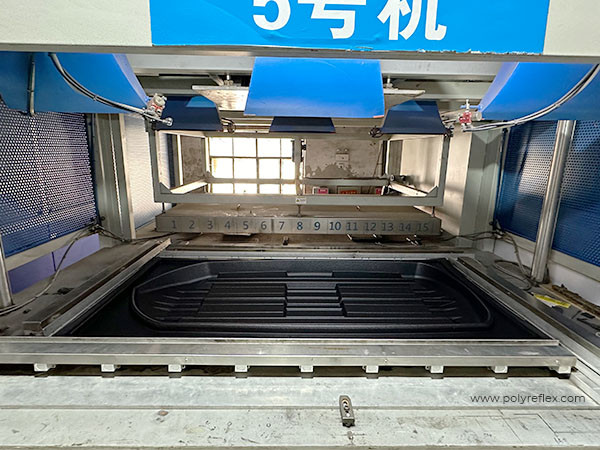
Roof Cargo Boxes Vacuum Forming
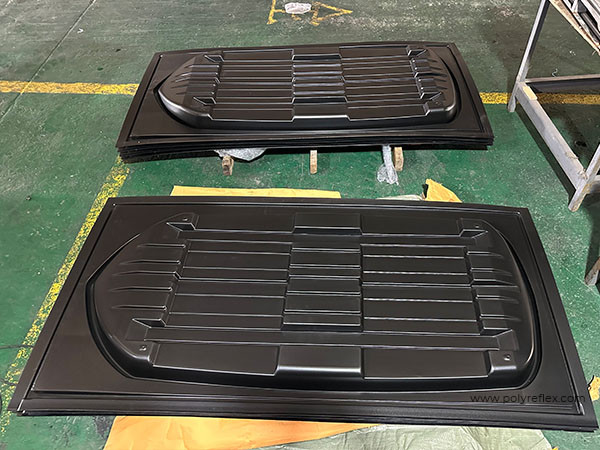
Roof Cargo Boxes after Vacuum Forming
5. From ABS Sheets to Finished Products: The Vacuum Thermoforming Process
Vacuum thermoforming transforms flat ABS sheets into three-dimensional plastic components through a series of heating, forming and finishing operations.
Understanding the basic process helps manufacturers select appropriate materials and develop suitable product designs.
Step 1: ABS Sheet Selection
The first step is selecting an ABS sheet that meets the product's requirements.
Important considerations include material grade, thickness, color, surface finish and intended application.
The sheet should be suitable for the required forming depth and final product performance.
Step 2: Sheet Heating
The ABS sheet is heated until it reaches a sufficiently softened state for forming.
Uniform heating is important because temperature distribution affects how the material stretches during the forming process.
Step 3: Vacuum Thermoforming
The heated sheet is positioned over or around a mold.
Vacuum pressure removes air between the sheet and the mold, drawing the softened material against the mold surface to create the required shape.
The mold determines the basic geometry and surface details of the formed component.
Step 4: Cooling and Demolding
After forming, the plastic component is cooled until it retains its intended shape.
The formed part is then removed from the mold for subsequent processing.
Step 5: CNC Trimming and Machining
The thermoformed component usually contains excess material around its edges.
CNC trimming and other machining operations are used to remove excess material and create the final product dimensions.
Depending on the design, drilling and other secondary operations may also be required.
Step 6: Quality Inspection
The finished component is inspected according to the project's requirements.
Common inspection items include:
Proper material selection and process control help ensure consistent results throughout production.
6. How to Choose the Right ABS Sheet for Thermoforming Projects
Selecting the right ABS sheet is an important part of developing a successful thermoformed product.
Different applications have different requirements, so manufacturers should consider several factors before confirming the material specification.
6.1 Sheet Thickness
Sheet thickness affects the material's forming behavior and the final component's structure.
For example, large equipment housings and automotive exterior components may require different thicknesses depending on their dimensions, forming depth and functional requirements.
Manufacturers should evaluate the expected material stretching during forming rather than selecting sheet thickness based only on the finished product's appearance.
6.2 Material Grade
Different ABS grades offer different combinations of impact resistance, rigidity, heat resistance and processing characteristics.
The appropriate grade should be selected according to the intended application and operating environment.
For components exposed to outdoor conditions, UV-resistant grades or alternative weatherable materials may be necessary.
6.3 Surface Finish
Surface appearance is particularly important for automotive components and equipment housings.
Depending on the product design, manufacturers may choose smooth, matte or textured ABS sheets.
The selected finish should be compatible with the desired appearance of the finished component.
6.4 Color Requirements
ABS sheets can be supplied in different colors to match product designs and customer requirements.
Common colors include black, white and gray, while customized colors may be considered for specific projects.
6.5 Forming Depth and Product Geometry
The shape of the finished component directly affects material stretching during thermoforming.
Deep cavities, sharp corners and complex geometries may require special attention during mold design and material selection.
Manufacturers should evaluate the product drawing or sample before confirming the suitable sheet specification.
6.6 Application Environment
The operating environment is another important consideration.
For example:
Selecting the right ABS grade according to actual working conditions helps improve the suitability of the finished product.
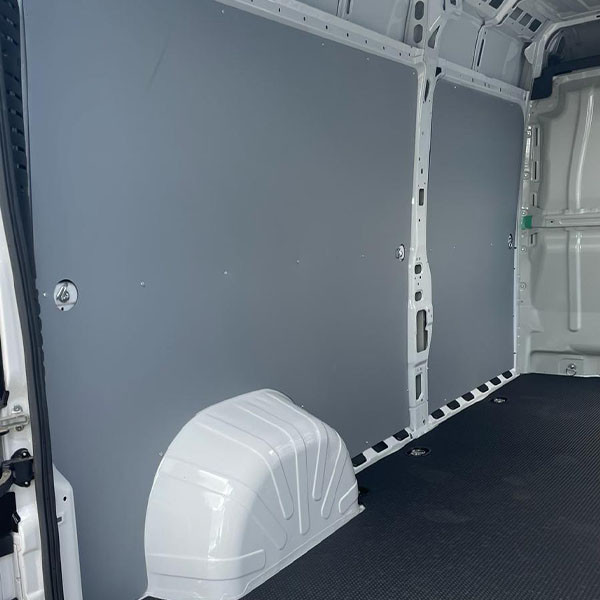
Lightweight PP bubble board and honeycomb panels for automotive interior wall, ceiling, and floor applications. Durable, moisture-resistant, and customizable.
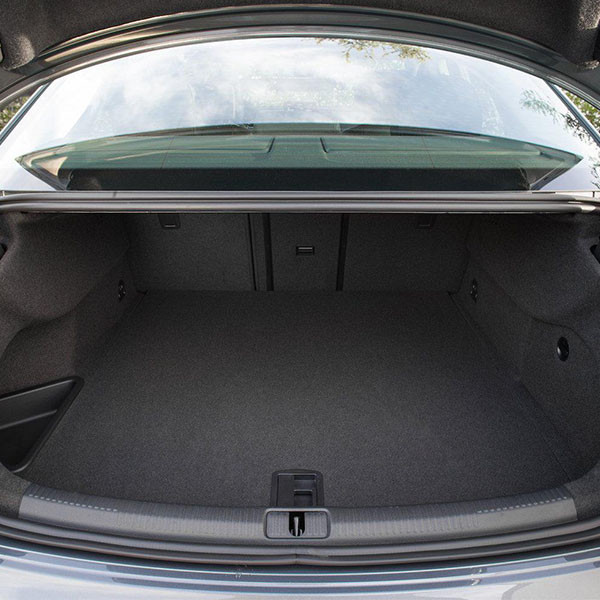
Lightweight and durable automotive trunk floor panel solutions using PP bubble board and honeycomb materials. Designed for high load capacity, moisture resistance, and OEM customization across modern vehicle cargo systems.
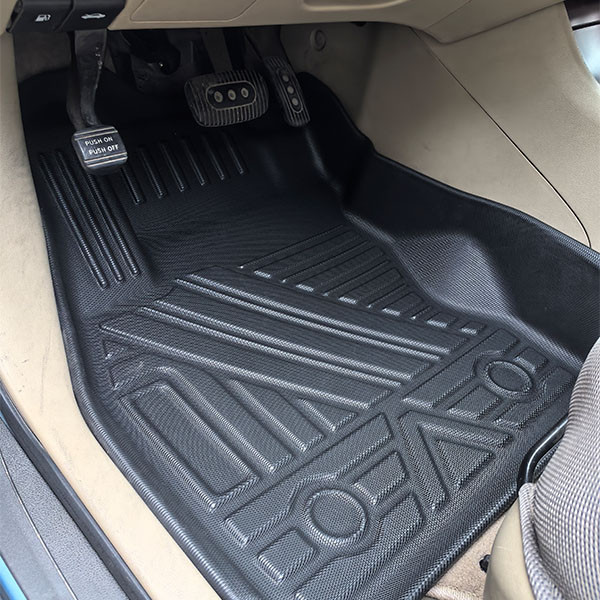
Polyreflex provides high-performance TPO/TPE thermoplastic sheets for automotive floor mats, trunk liners, and cargo protection systems, offering excellent durability, waterproof performance, and thermoforming compatibility for OEM applications.
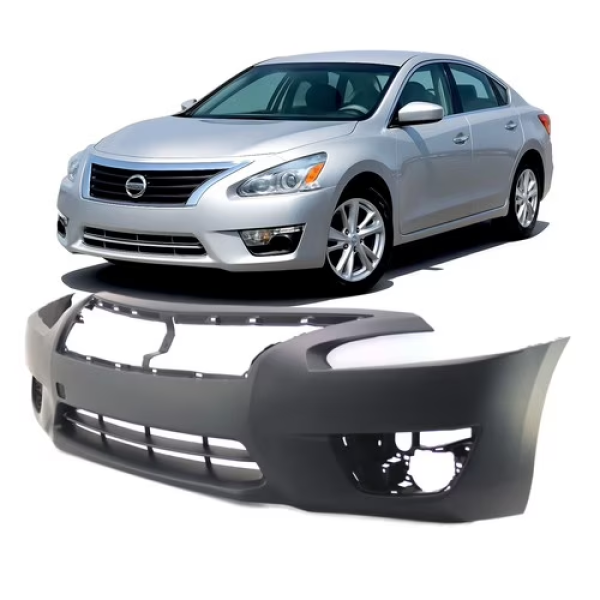
High-performance automotive exterior body panels made from ABS and TPO materials. Polyreflex offers durable, lightweight, and customizable thermoformed solutions with excellent surface finish and weather resistance.
7. ABS Sheet Solutions from Polyreflex
As a plastic sheet manufacturer, Polyreflex provides ABS sheet solutions for customers involved in plastic product manufacturing and thermoforming applications.
ABS sheets can serve as the starting material for producing various customized plastic components, including automotive parts, equipment housings, protective covers and industrial packaging trays.
For different project requirements, customers can discuss material specifications and sheet options with the Polyreflex team.
Key considerations include:
Whether you are developing automotive exterior components, protective equipment housings or reusable industrial packaging, selecting a suitable ABS sheet is an important step toward achieving the desired product performance and appearance.
Polyreflex welcomes inquiries from plastic product manufacturers, thermoforming companies and industrial buyers looking for ABS sheet materials for customized manufacturing projects.
8. Frequently Asked Questions
Q1: What products can be made from thermoformed ABS sheets?
Thermoformed ABS sheets can be used to produce automotive roof cargo boxes, front lips, fender flares, equipment protective covers, tanning equipment housings, packaging components and custom dunnage trays.
Q2: Is ABS suitable for vacuum forming large plastic housings?
Yes. ABS sheets offer good thermoforming performance and are suitable for producing large plastic housings, protective covers and customized three-dimensional components using vacuum forming.
Q3: What thickness of ABS sheet is suitable for thermoforming?
The suitable thickness depends on the product size, forming depth, structural requirements and material stretching during forming. Customers can provide drawings or samples for material selection.
Q4: Can thermoformed ABS products be customized in different shapes and colors?
Yes. ABS thermoformed products can be customized in different shapes, dimensions, colors and surface finishes using application-specific molds and suitable ABS sheets.
Q5: Can ABS sheets be used for reusable industrial packaging trays?
Yes. ABS sheets can be thermoformed into reusable dunnage trays with customized cavities to position and protect components during storage, transportation and production.
9. Conclusion
ABS sheet thermoforming provides a flexible manufacturing solution for producing customized plastic components across different industries.
From automotive roof cargo boxes and exterior components to fitness equipment covers, tanning equipment housings and reusable industrial dunnage trays, ABS sheets can be formed into a wide variety of shapes to meet specific product requirements.
Choosing the right ABS sheet involves more than considering material thickness or appearance. Material grade, forming depth, surface finish and operating environment all play important roles in determining the suitability of the finished component.
As a plastic sheet manufacturer, Polyreflex supports customers looking for ABS sheet materials for thermoforming and customized plastic product manufacturing.
Looking for ABS sheets for your next thermoforming project? Contact Polyreflex to discuss your material requirements, application and customization needs.